
 Community
 Video Library
 Agent Training
 Freshservice
 Freshdesk
 Freshchat
 Freshcaller
 Freshsales
 Freshteam
 Freshworks Neo
 Freshsurvey
 Freshservice for MSP
 TABLE OF CONTENTS
- Overview
- Install the Google Drive app
- Configure storage mapping for a document template
- View document upload status from the ticket
- View app logs and retry failed document uploads
- Upload failure handling
- Admin notifications for upload failures
- Frequently asked questions
- Known limitations
Overview
Freshservice lets you automatically upload generated documents to preconfigured folders in Google Drive, eliminating the need to download and manually re-upload files.
By mapping a Google Drive folder to a document template, teams such as HR and other business functions can ensure that employee-related documents, such as offer letters, onboarding forms, and compliance records, are stored in the correct location immediately after they are generated. This helps organizations maintain consistent storage practices, reduce manual effort, and securely manage documents that follow strict naming, access, or compliance requirements.
This approach helps your organization:
Reduce manual effort for agents.
Prevent documents from being misplaced or stored only within tickets.
Maintain audit and compliance readiness.
Keep employee documents accessible beyond the ticket lifecycle.
Install the Google Drive app
Prerequisites
Before you install the Google Drive app, ensure that the following prerequisites are met:
Global Admin privileges in Freshservice.
Access to the target Google Drive account or shared drives where you want to store the documents.
A Google Workspace user account with permission to install third-party apps. If your organization restricts app installs, ask your Google Workspace administrator to allow the Freshservice app.
To install the app
To install the Google Drive app, follow these steps:
The Google Drive app is installed and managed at the account level, with only one installation allowed per account.Log in to your Freshservice account and go to Marketplace Apps.
Search and select the GDrive doc storage app, and click Install.
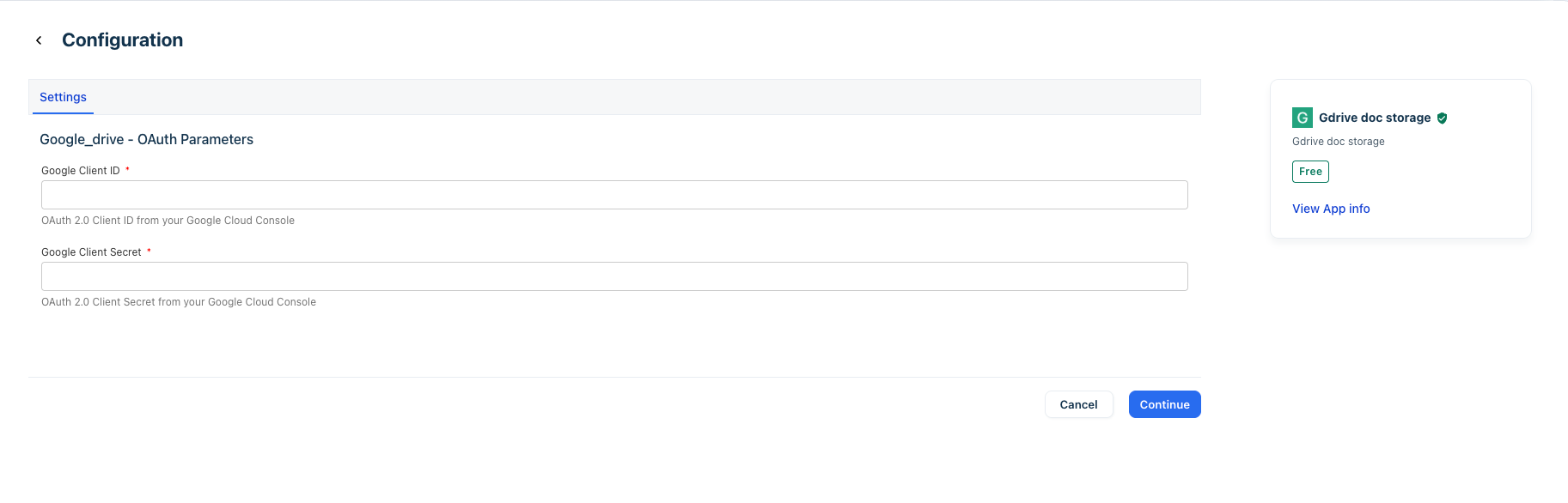
On the Configuration page, enter the Google Drive OAuth parameters (Google Client ID and Google Client Secret). Then, click Continue. For information about generating these credentials, see this article.
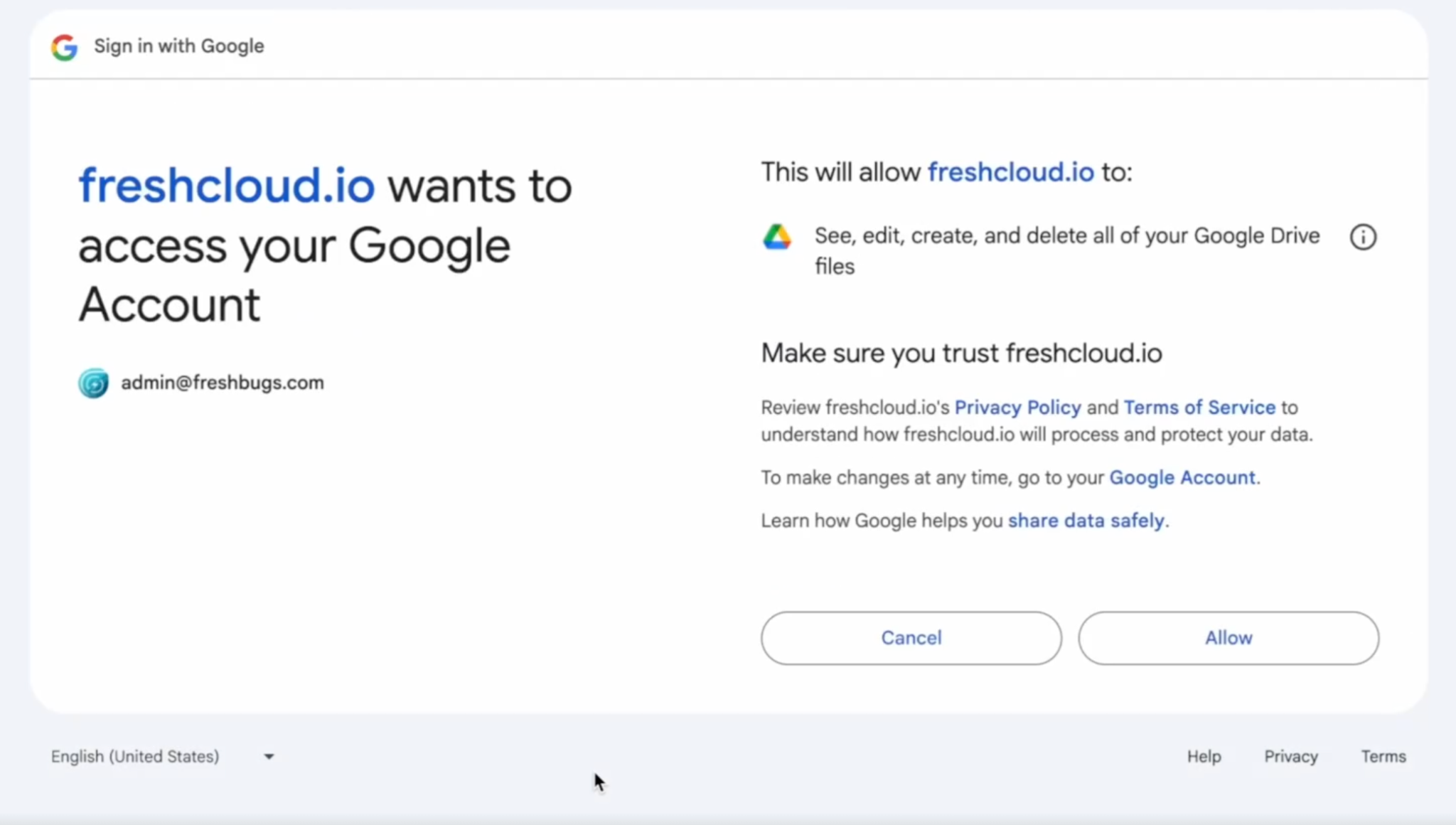
Choose the relevant Google account for doc storage.
Review and allow the Google Drive policy and terms of service.
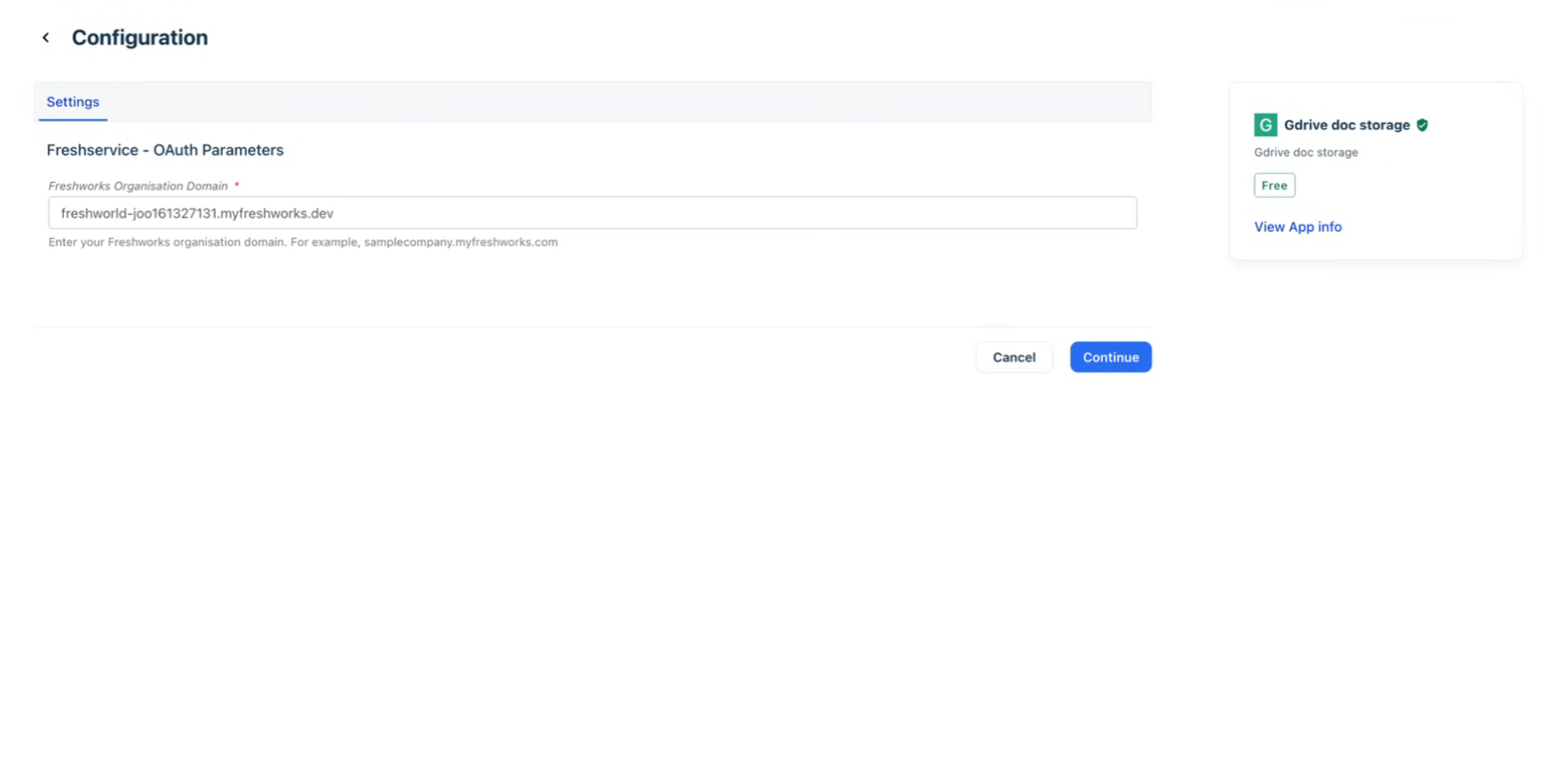
Enter or validate the Freshservice OAuth parameters (Freshworks Organization Domain). Then, click Continue.
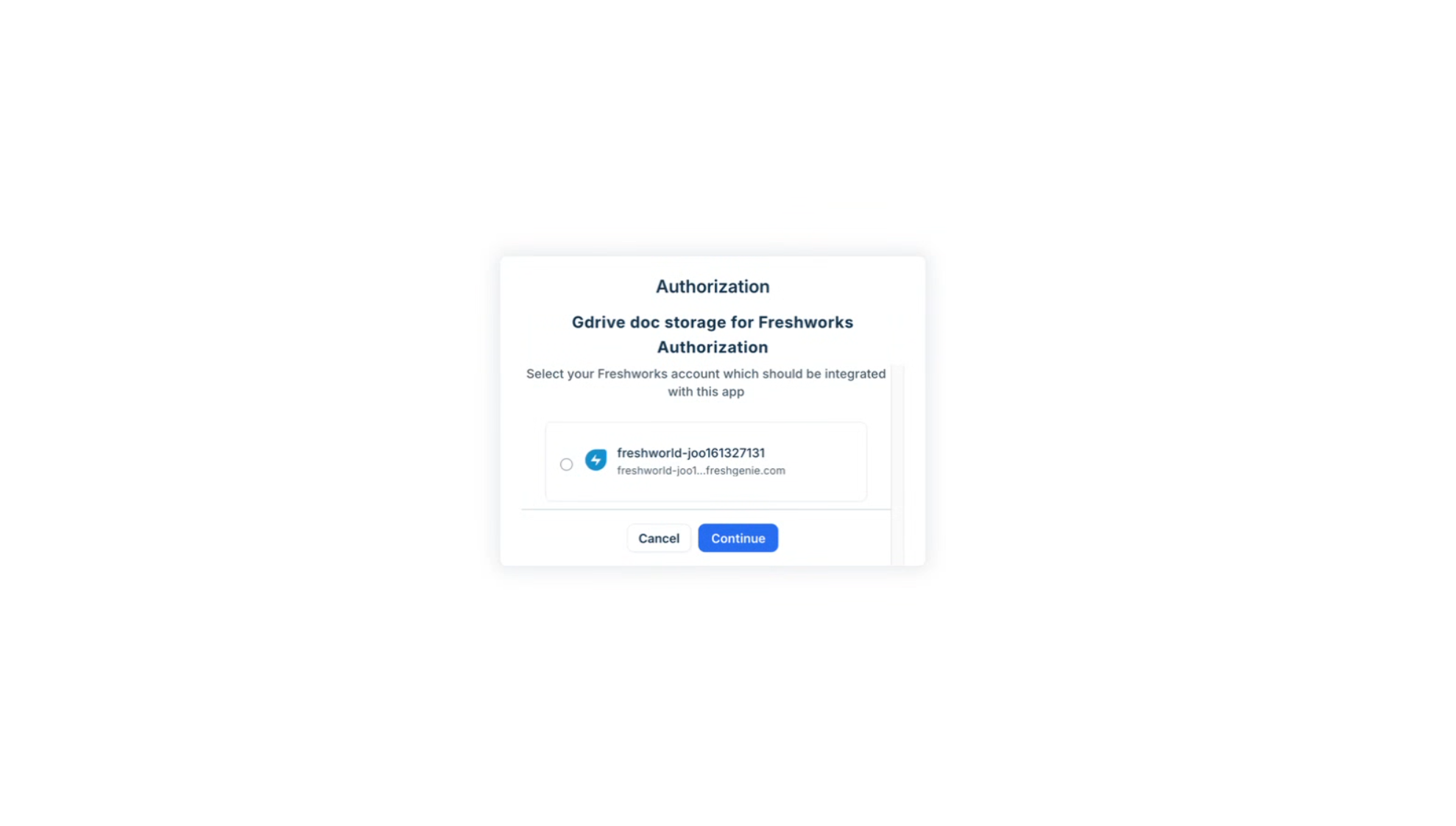
Select your Freshworks account to authorize GDrive doc storage, and click Continue.
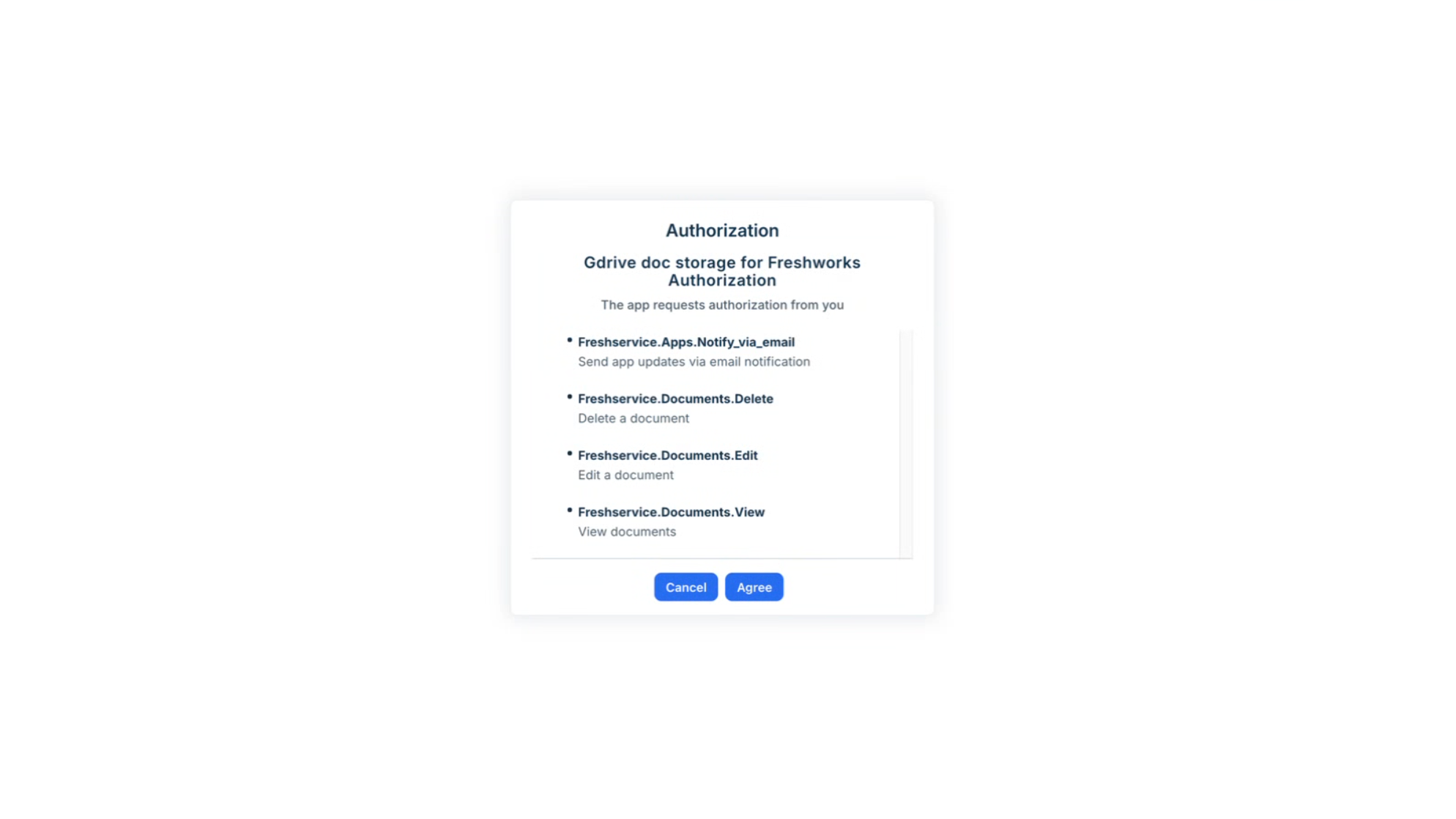
Review the authorization options, and click Agree.
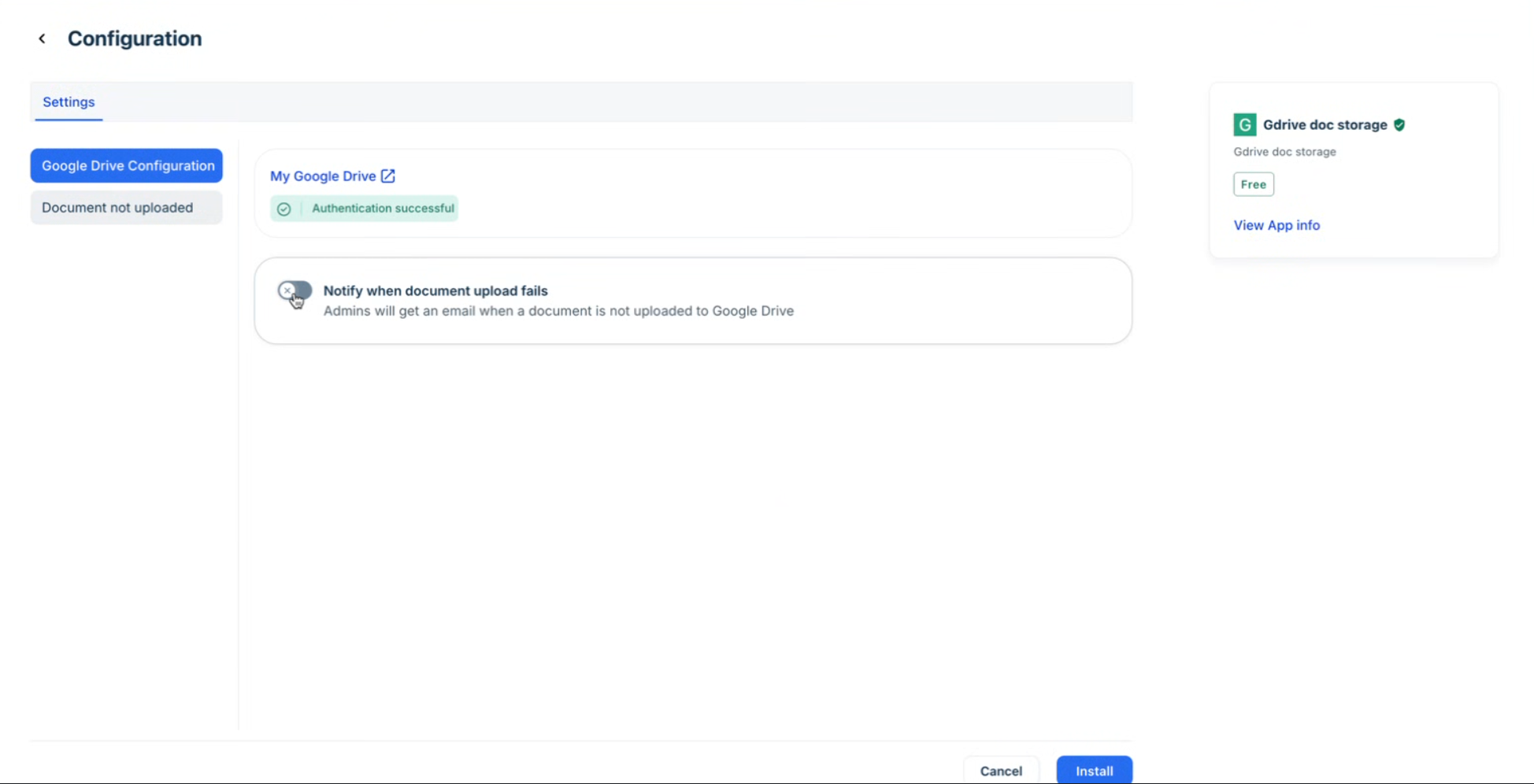
Click Install to complete the installation.
Configure storage mapping for a document template
After you install the Google Drive app, map the Google Drive location where generated documents will be saved.
Storage mapping is defined at the document template level, so the behavior stays consistent across service items, workflows, and future automations.
Prerequisites
Access to document template settings.
The target folder already exists in Google Drive. Freshservice does not create folders for you.
If you want to store documents in a shared drive, the connected Google account has at least Content Manager access to that drive.
To configure storage mapping
To configure storage mapping, follow these steps:
Go to Admin > Document Templates.
Open the document template you want to configure.
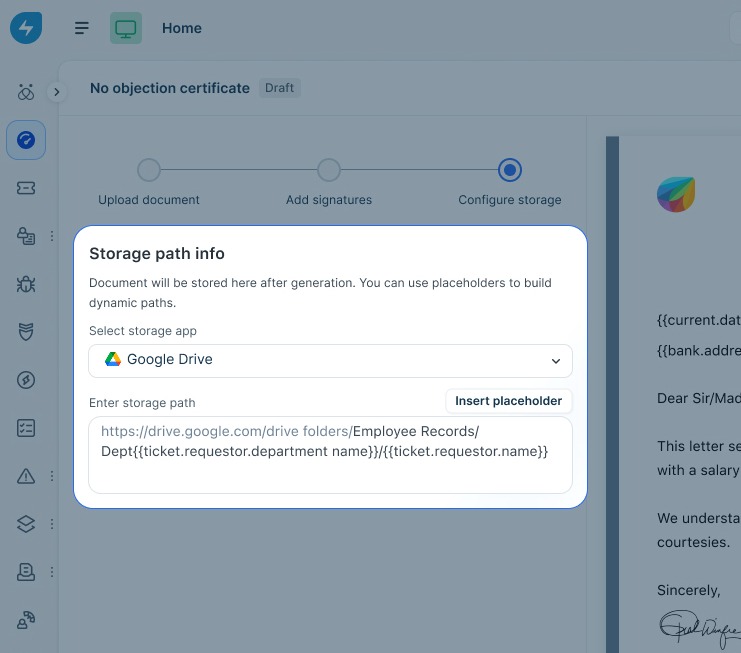
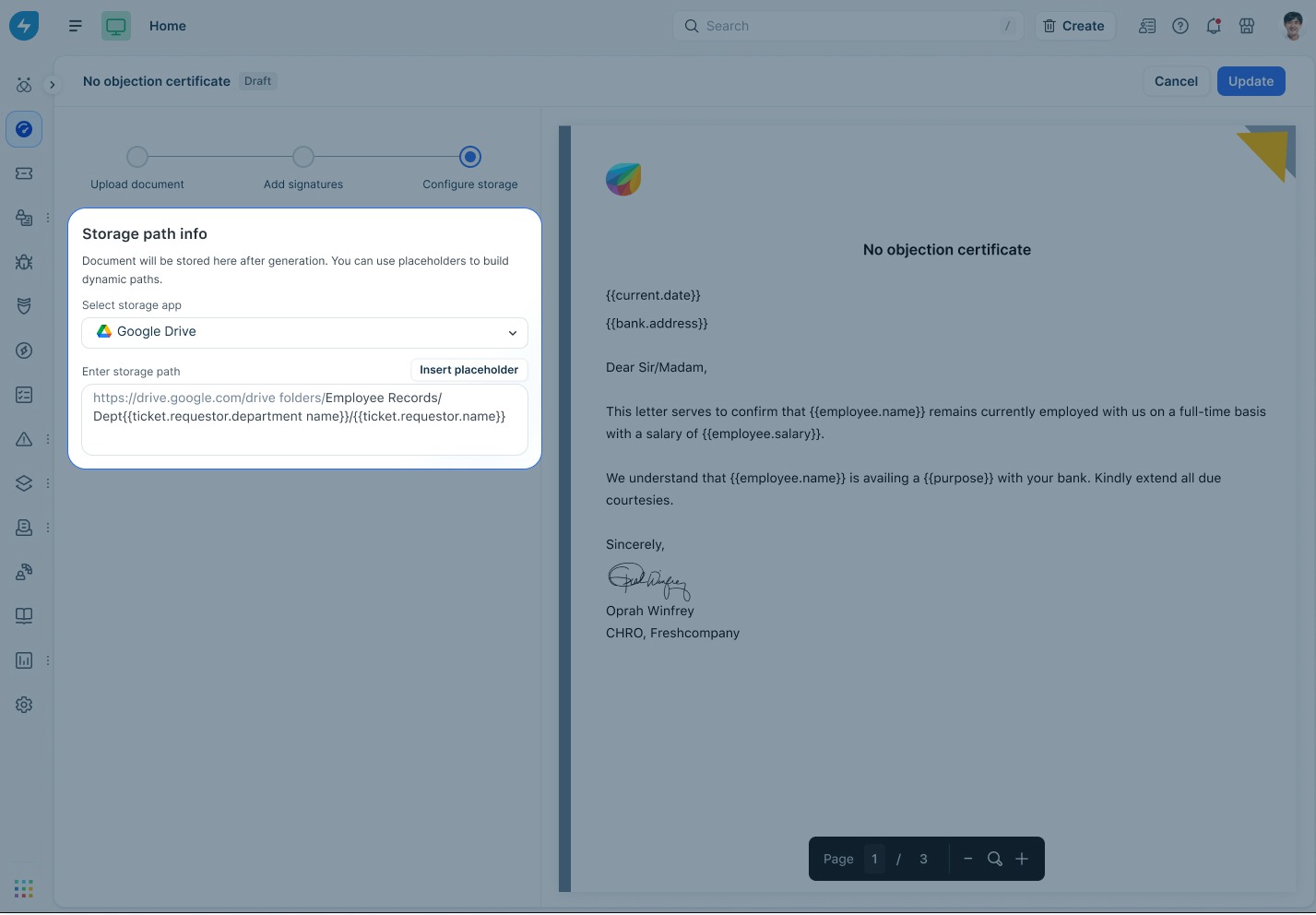
In Storage settings, select Google Drive as the storage app.
In the Storage path field, select or enter the target Google Drive folder path. You can also include dynamic placeholders in the storage path, such as the employee name or ID stored in Freshservice as Requester or Requested for fields.
For example: HR Documents/{{Requester.Name}}/Onboarding. During document generation, Freshservice resolves these placeholders and uploads the document to the matching Google Drive folder.Save the document template. The next time the document is generated, Freshservice uploads it to the mapped Google Drive folder and keeps the file linked to the ticket for reference.
Note:
Storage mapping is point-in-time. If you change the folder path later, documents that have already been generated stay in their original location.
For e-signature documents, the upload happens after the signing process is complete.
View document upload status from the ticket
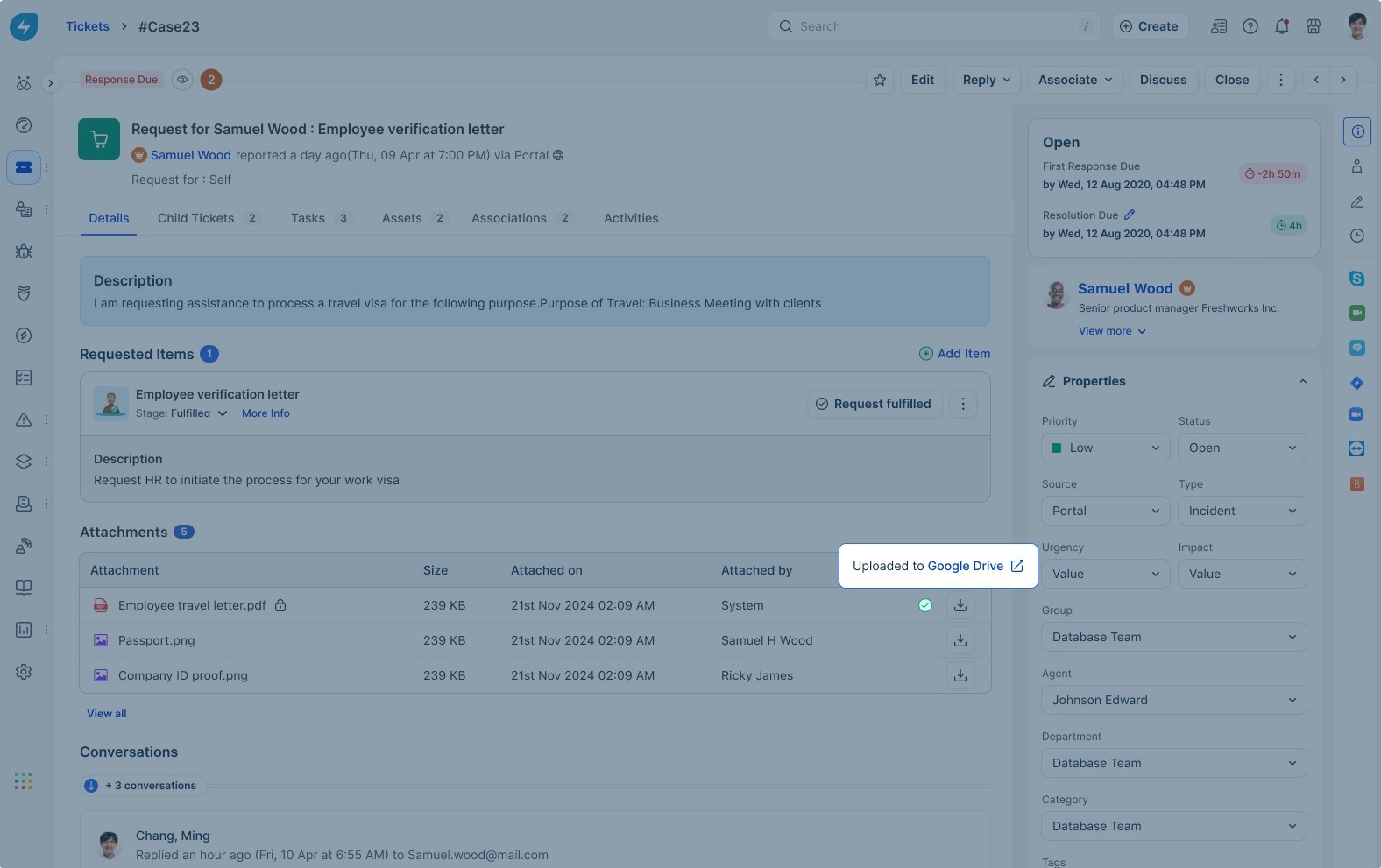
After a document is generated, agents can check whether it was successfully uploaded to Google Drive without leaving the ticket. This helps confirm that storage is complete and makes failures easy to spot.
To view the upload status
To view the upload status, follow these steps:
Open the ticket where the document was generated.
Go to the Attachments section.
Locate the generated document. For each document, Freshservice shows the following details:
View app logs and retry failed document uploads
Admins can review document upload activity and retry failed uploads from the Google Drive app settings. This makes it easy to fix upload problems without regenerating documents.
To view app logs
To view app logs, follow these steps:
Go to Admin > Apps > Installed Apps.
Open the Google Drive app.
Select App logs. The logs show the following information:
To retry failed uploads
Retry is supported only as a bulk action. Existing files in Google Drive are not overwritten. If a naming conflict occurs, Freshservice appends the date and time to the file name. For example: TemplateName_RequesterName_v2_2026-01-17_14-32-10.pdf.
To retry failed uploads, follow these steps:
In App logs, identify entries with a Failed status. Fix the underlying issue in the Google Drive app or in Google Drive itself before continuing.
After the issue is resolved, select one or more failed entries.
Select Retry.
Freshservice attempts the upload again using the original storage configuration.
Upload failure handling
If a document upload fails, Freshservice shows the failure reason in the app logs.
Common failure scenarios include:
An invalid or incorrect folder path.
Insufficient permissions for the target Google Drive folder or shared drive.
The connected Google account has been revoked, suspended, or has its OAuth token expired.
The target folder has been deleted or moved to Trash in Google Drive.
The Google Drive storage quota for the connected account has been exceeded.
Agents can share the failure message with an admin, who can fix the issue and retry the upload from the Google Drive app settings.
Admin notifications for upload failures
Failure notifications are sent in batches, so admins can review and act on multiple issues at once without watching the logs continuously.
Admins can then use the app logs to identify failed uploads and retry them in bulk.
Frequently asked questions
1. Can I configure different folders for different templates?
Yes. Storage mapping is configured for each document template, so every template can point to a different Google Drive folder.
2. Can I change the storage location after documents are generated?
No. Storage mapping is applied at the time a document is generated. Any changes apply only to future documents.
3. Are restricted documents supported?
Yes. Restricted documents can also be uploaded to Google Drive. Access to the Google Drive link follows the existing sharing and permission rules of the target folder.
4. Does this work for documents generated automatically through workflows?
Yes. Documents generated through workflows or auto-send actions follow the same upload behavior and status tracking.
5. Will files be overwritten if the same document is generated again?
No. Freshservice prevents overwrites.
New versions are saved with an incremented version number.
If a naming conflict still occurs, the system appends the date and time to the file name so that every file has a unique name.
6. Does Freshservice create folders automatically in Google Drive?
No. Folder creation is not supported. The target folder must already exist in Google Drive, and the connected account must have edit access to it.
7. Can I use a shared drive instead of My Drive?
Yes. You can map the storage path to a folder in a shared drive. The connected Google account must have at least Content manager access to that shared drive so that Freshservice can upload files.
8. What happens if the Google Drive app is disabled or uninstalled?
The behavior depends on whether the app is disabled or uninstalled:
Disabled: Existing mappings are kept, but no new uploads happen until the app is enabled again.
Uninstalled: All template mappings are removed, and Google Drive links are no longer shown on tickets.
Known limitations
The current version of the Google Drive integration has the following limitations:
Freshservice does not automatically create folders in Google Drive. The target folder must already exist.
Folder-level permissions are managed entirely in Google Drive. Freshservice uploads a file to the target folder, and the file inherits the sharing settings of that folder.
Only one storage path can be configured for each document template.
Retention policies are managed in Google Drive (or in Google Vault) and are not controlled from Freshservice.
Only one Google account can be connected to the app for each Freshservice account.