
 Community
 Video Library
 Agent Training
 Freshservice
 Freshdesk
 Freshchat
 Freshcaller
 Freshsales
 Freshteam
 Freshworks Neo
 Freshsurvey
 Freshservice for MSP
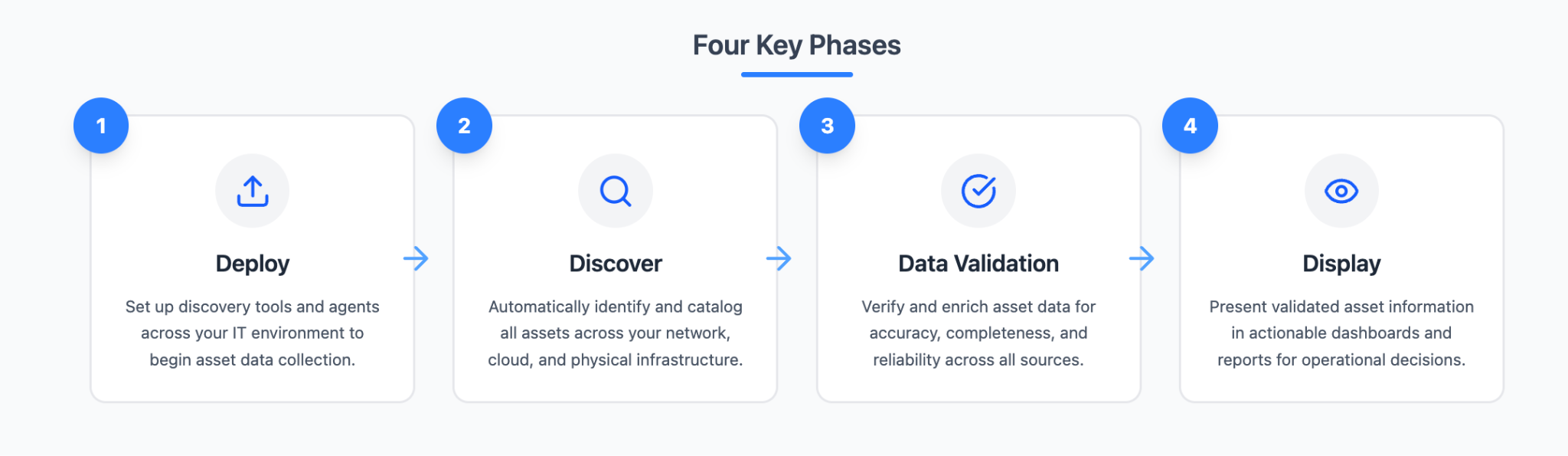
 Asset Management helps IT teams build accurate, reliable, and actionable asset data. This structured approach ensures assets are discovered correctly, validated for accuracy, and presented in a way that supports operational and business decisions.
The implementation has four key phases:
Deploy
Discover
Data validation
Display
Deploy
The Deploy phase prepares your environment for asset discovery by installing and configuring the required discovery components. This includes setting up Remote collectors to enable discovery across distributed networks and restricted environments. If Windows systems are in scope, Windows discovery services are configured to support discovery of Windows-based assets.
This phase also includes setting up appropriate access permissions using preferred credentials, port requirements, secret settings, and cloud roles, while following the principle of least privilege. Connectivity checks are performed to ensure discovery can communicate with in-scope systems successfully.
Discover
The Discover phase focuses on identifying assets using the Scan and Discovery. Discovery scopes such as IP ranges, Active Directory, cloud accounts, and schedules are configured, and scan and discovery jobs are executed to inventory assets.
After discovery runs, discovery status and unprocessed device records are reviewed to assess coverage and accuracy. Any discovery issues are resolved, and scans are scheduled to run automatically to keep asset data continuously up to date. For more information about the Discover phase, see Discover.
.
Data validation
The Data Validation phase ensures the accuracy and completeness of discovered asset data. Asset records in the CMDB are reviewed and validated using asset history, lifecycle events, and related attributes.
In this phase, discrepancies are corrected, missing information is added using custom fields or CI profiles, and asset records are standardized. This phase helps establish the CMDB as a trusted source of truth.
Display
The Display phase focuses on making asset data usable and meaningful for IT teams and stakeholders. Asset information stored in the CMDB is organized and surfaced through views, and dashboards. Reports can be created and scheduled to provide ongoing visibility into asset status and changes.