
 Community
 Video Library
 Agent Training
 Freshservice
 Freshdesk
 Freshchat
 Freshcaller
 Freshsales
 Freshteam
 Freshworks Neo
 Freshsurvey
 Freshservice for MSP
 TABLE OF CONTENTS
- Freshservice layered model
- Cross-layer relationships (key insight)
- High-Level ERD
- Asset Management ERD
- Ticketing ERD (ITSM Core)
- User and Organization model
- Entity definitions (Sample Data Dictionary)
Overview
This document provides a data model of Freshservice, outlining core entities, their relationships, and a layered structure.
It is intended to:
Help customers understand entity relationships across modules in Freshservice
- Support integration architecture and governance
Provide a reference model for CMDB and data design
The model is presented using two complementary approaches.
The first approach uses a layered structure to group entities based on their functional role within the platform (for example, user interaction, service processes, asset management, and organizational structure). This simplifies the overall system by dividing it into well-defined domains and provides a structured view of the platform.
The second approach focuses on cross-layer relationships, which describe how entities interact across these domains. For example, tickets are associated with assets and users, changes impact infrastructure components, and organizational entities define ownership and responsibility.
Together, these approaches provide both structural organization and interaction context. The layered model defines the set of entities, while cross-layer relationships describe how these entities operate within the system. This combined approach supports use cases such as integration design, data flow analysis, and governance modeling.
Freshservice layered model
Freshservice entities are organized into the following layers:
Layer A: Experience layer (User Interaction)
Represents how users interact with the system.
Entities:
Incident
Service Request
Problem
Change
Release
Purpose: Capture demand, issues, and operational workflows
Layer B: Service and process layer
Represents service delivery and operational processes.
Entities:
Project
Project Task
Change
Release
Problem
Purpose: Manage execution of services and lifecycle processes
Layer C: Asset and configuration layer
Represents infrastructure and resources ( CMDB).
Entities:
Asset (Inventory)
Software
Contract
Purchase Order
Vendor
Product
Purpose: Track IT assets, relationships, and lifecycle
Layer D: Organization layer
Represents people and ownership.
Entities:
Requester
Agent
Agent Group
Requester Group
Department
Purpose: Define ownership, access, and responsibility
Layer E: Supporting metadata layer
Represents system-level attributes and extensibility.
Entities:
Custom Fields
Categories
Status
Priority
Tags
Purpose: Enable customization and classification
Cross-layer relationships (key insight)
The following cross-layer relationships describe how entities interact across different layers of the model.
Tickets (Layer 1) → Assets (Layer 3)
Assets (Layer 3) → Contracts / Vendors
Tickets (Layer 1) → Users (Layer 4)
Projects (Layer 2) → Tickets (Layer 1)
Users (Layer 4) → Departments
This is what enables:
Integration
Governance
CMDB modeling
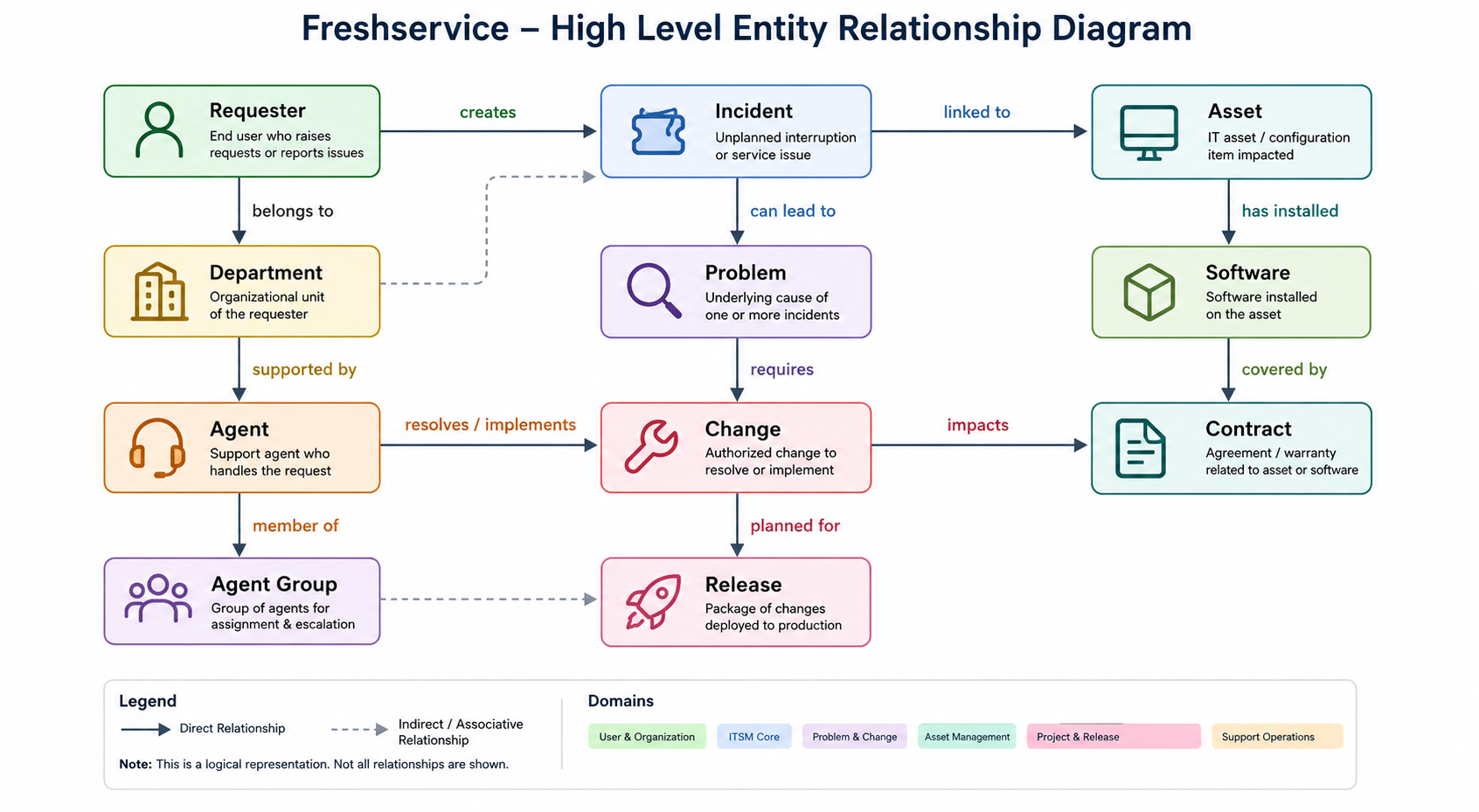
High-Level ERD
This diagram provides a high-level view of core entities and their relationships across the Freshservice platform. It highlights key interactions between domains to help understand overall system structure.
Asset Management ERD
This diagram focuses on asset management entities and their relationships within Freshservice. It illustrates how assets are connected to contracts, software, procurement, and ownership structures.
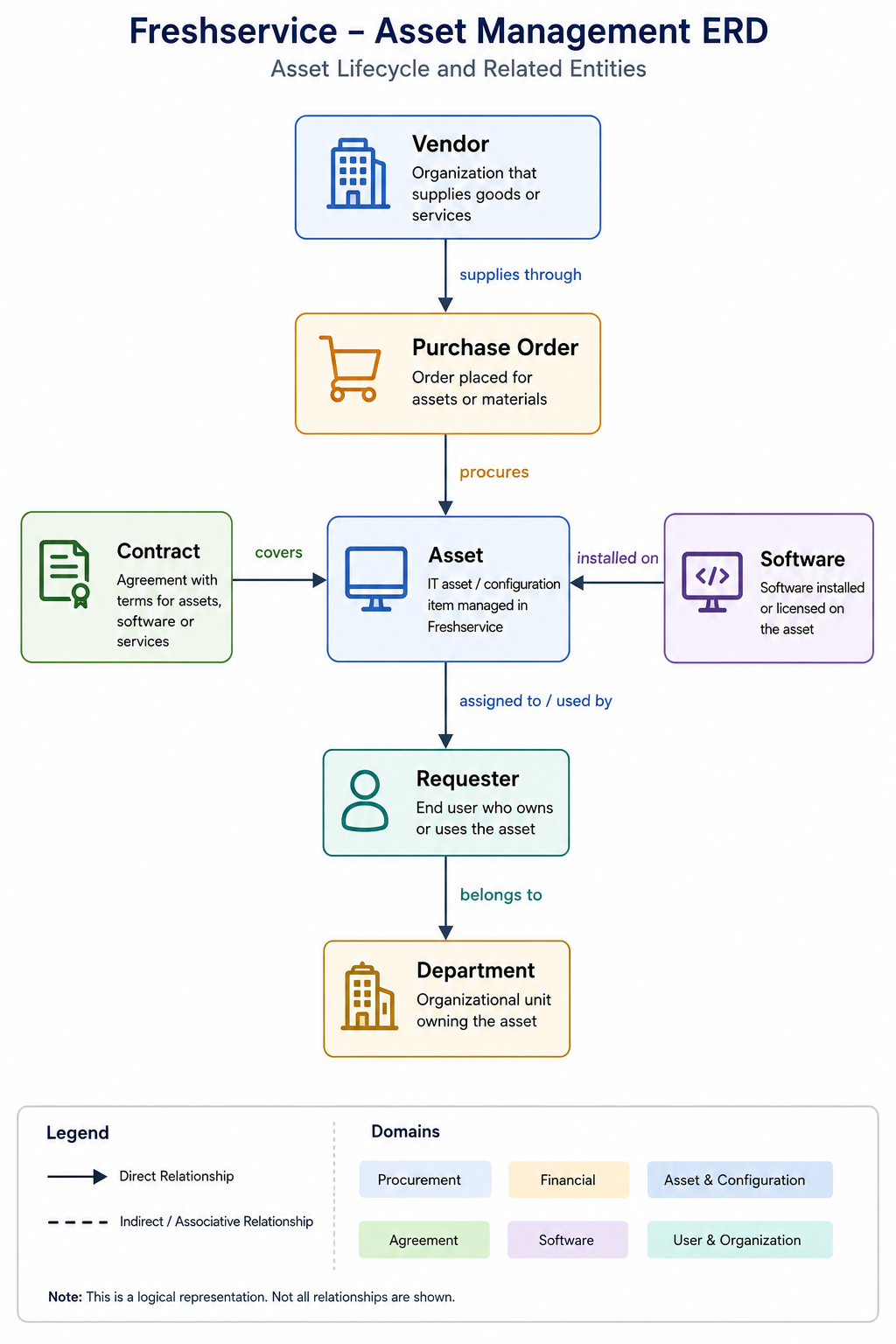
Key Relationships:
Asset ↔ Software (installed applications)
Asset ↔ Contract (licensing/warranty)
Asset ↔ Purchase Order (procurement)
Asset ↔ User (assignment)
Asset ↔ Department (ownership)
Ticketing ERD (ITSM Core)
This diagram illustrates the core ITSM entities and their relationships within Freshservice. It highlights how tickets interact with changes, problems, assets, and users across workflows.
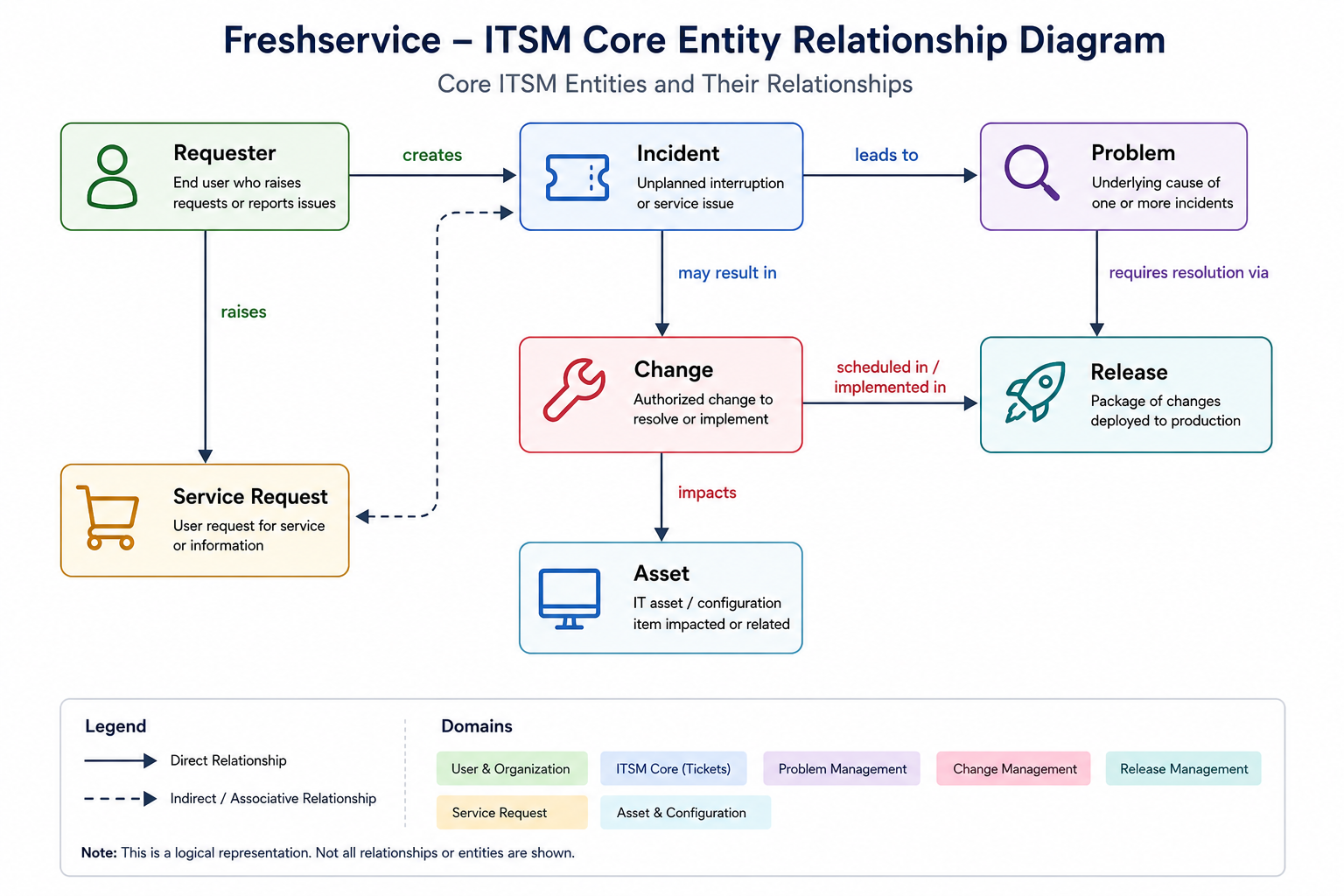
Key Relationships:
Incident ↔ Problem (root cause)
Incident ↔ Change (caused by)
Change ↔ Release (deployment)
Tickets ↔ Assets (impact tracking)
User and Organization model
This diagram represents user and organizational entities and their relationships within Freshservice. It illustrates how users, groups, and departments are structured to support ownership and access control.
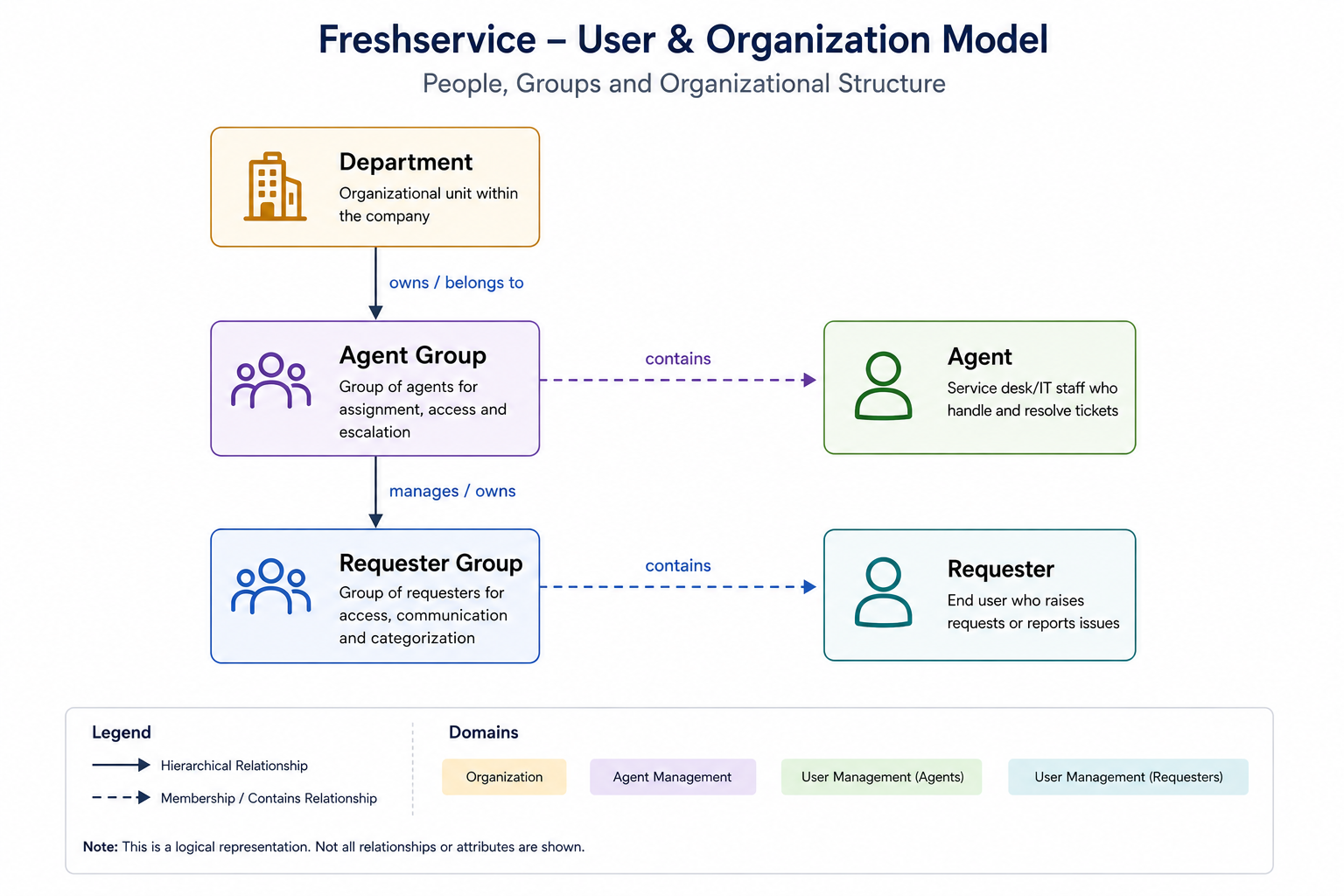
Key Concepts:
Agents handle tickets
Requesters raise requests
Groups manage assignment and escalation
Entity definitions (Sample Data Dictionary)
This section provides sample definitions of key entities in the Freshservice data model.
It includes descriptions and relationships to support understanding of entity roles and interactions.