
 Community
 Video Library
 Agent Training
 Freshservice
 Freshdesk
 Freshchat
 Freshcaller
 Freshsales
 Freshteam
 Freshworks Neo
 Freshsurvey
 Freshservice for MSP
 Application Dependency Mapping (ADM) builds insightful models of IT services and applications in the context of your business services.
After configuring and running autodiscovery jobs, the dependency mapping module picks up on communication patterns, which you shape through Application Groups. Application Groups are generated using sets of rules that define the starting points for your applications, and Logic Templates define how discovery traverses the network and when it stops for each application.
Add Application Groups to your Business Services to visualize and organize the results in a way that is required for your business.
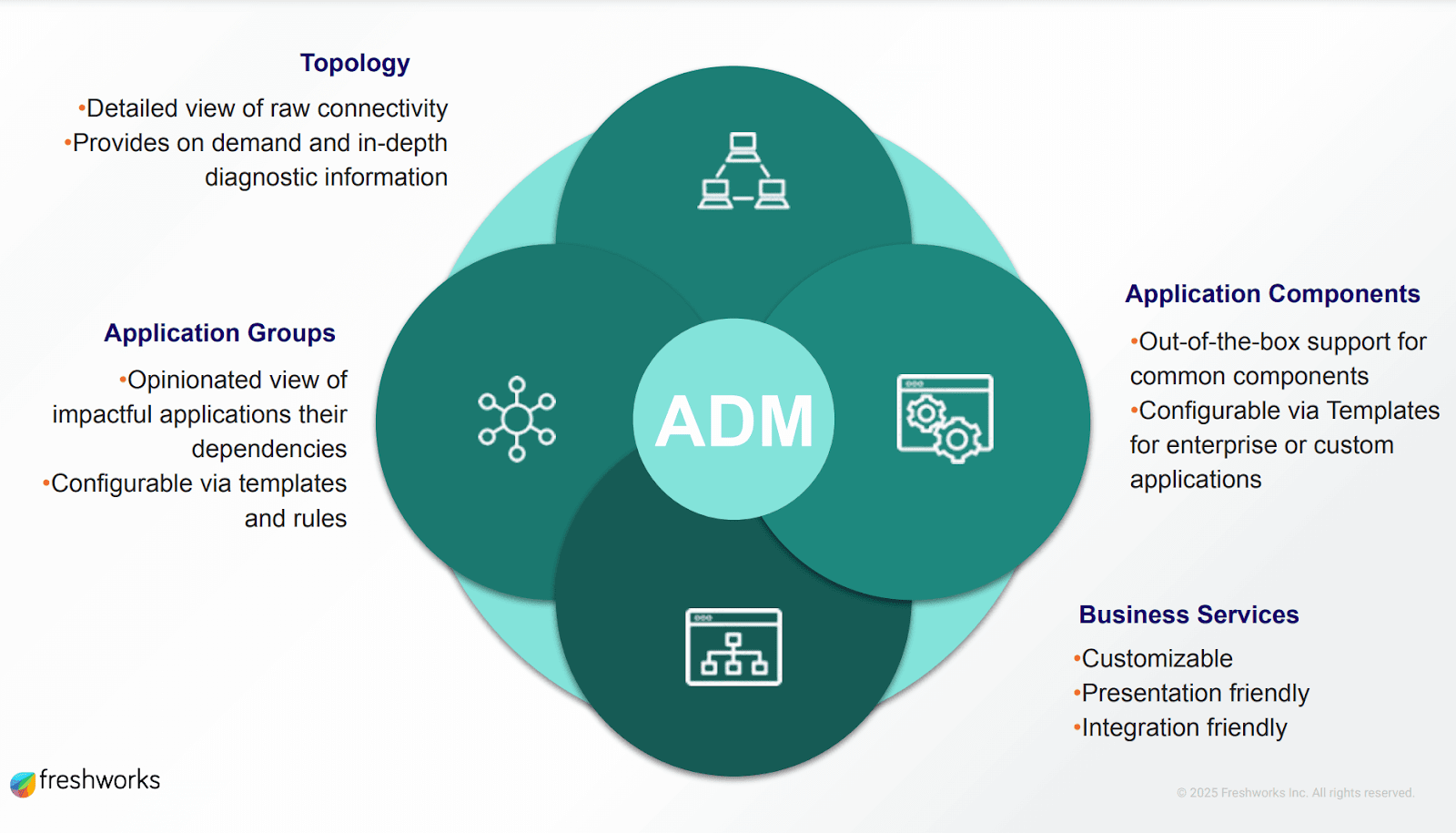
ADM features overview
ADM consists of the following components that work together to map dependencies effectively:
Discover services to services mapping: View which service on a machine or instance is connected to which other services on other machines.
Automate Application Component grouping: Automatically add Application Components based on groupings of services on a server. For example, once different Oracle services running on a machine are discovered, those services will automatically group together as an Oracle application.
Grab the configuration data for major applications: View config details and for some software, the actual configuration file contents of certain applications. These applications include Oracle, Microsoft SQL, MongoDB, PostgreSQL, MySQL, Cold Fusion, IIS, Apache HTTPD, and more.
Automate Periodic sampling jobs: Automate Periodic Jobs for both port and database connections to gain a comprehensive view of applications as you use these resources over time. This will enhance the discovery beyond a point in time usage.