 Community
 Video Library
 Agent Training
 Freshservice
 Freshdesk
 Freshchat
 Freshcaller
 Freshsales
 Freshteam
 Freshworks Neo
 Freshsurvey
 Freshservice for MSP
 Asset Management enables organizations to discover, track, and manage their hardware, software, and cloud resources from a centralized platform. It allows IT teams to maintain a single, reliable source of asset information. With Asset management you can:
Maintain accurate and up-to-date asset records through automated discovery and centralized management.
Improve visibility into asset ownership, location, and lifecycle status.
Enable faster issue resolution with reliable and accessible asset information.
Support audit and compliance requirements with asset history and lifecycle tracking.
Core capabilities
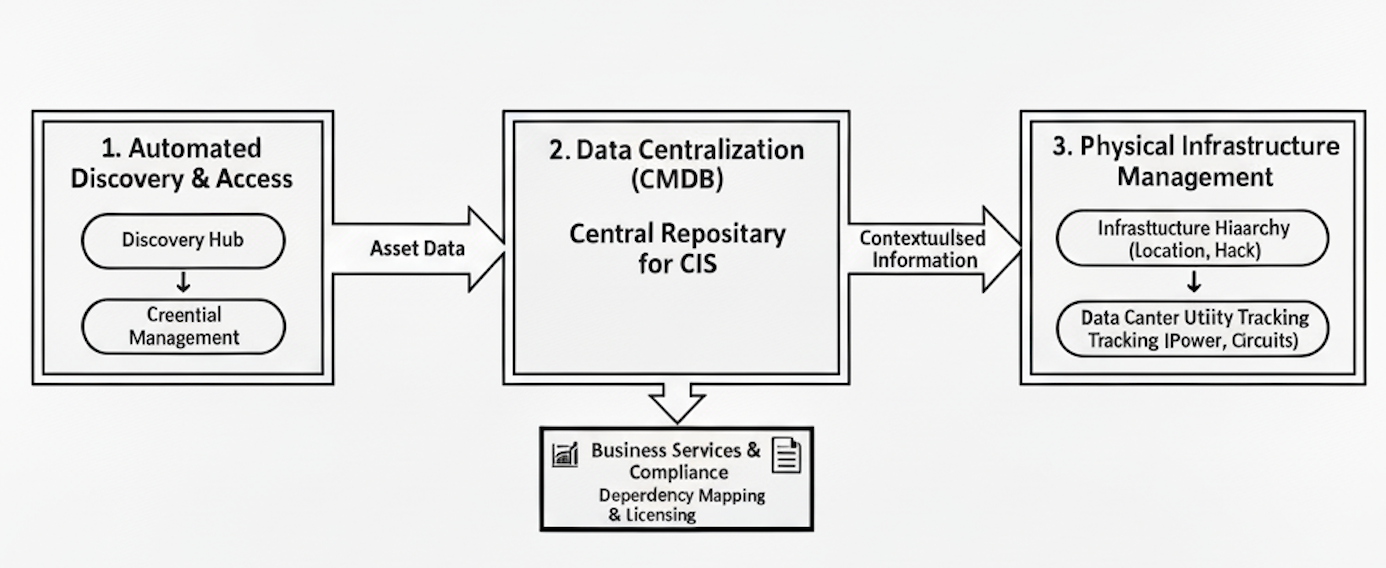
Asset management provides a unified framework for identifying, organizing, and securing your IT ecosystem. By integrating automated discovery with physical and logical mapping, the platform ensures that every hardware and software component is accounted for throughout its lifecycle.
Automated Asset Discovery and access
Asset management identifies network-connected devices and secures the credentials required to scan them. Use these features to maintain an accurate, real-time inventory across cloud and on-premises environments.
Scan and discover: Automates the detection of devices across diverse cloud and on-premise environments. It uses Active Directory integration and customizable scanning schedules to ensure the inventory remains current without manual intervention.
Secret vault: Acts as a hardened repository for the keys, roles, and credentials required for deep-system scans. This ensures that discovery agents have the necessary permissions to retrieve configuration data without compromising sensitive access logs.
Data Centralization and Operational Intelligence
You can manage lifecycles and evaluate the impact of assets on business operations. It helps you to link hardware and software to specific services to ensure contract compliance and reduce financial risk.
Configuration Management Database (CMDB): Serves as the single source of truth for all Configuration Items (CIs). By linking assets to specific business services and tracking licenses or contracts, it minimizes financial risk and simplifies audit readiness through dependency mapping.