
 Community
 Video Library
 Agent Training
 Freshservice
 Freshdesk
 Freshchat
 Freshcaller
 Freshsales
 Freshteam
 Freshworks Neo
 Freshsurvey
 Freshservice for MSP
 If emails fail to convert into Freshservice tickets, review these key items to resolve the issue:
When all incoming emails to your support mailbox fail to convert into tickets, verify that your forwarding rule is configured properly. Emails are routed and created as Freshservice tickets only when active forwarding is enabled. To test if the forwarding address functions correctly, send a test message to the forwarding address in Admin > {Workspace settings} > Channels > Email > Email Settings and Mailboxes.
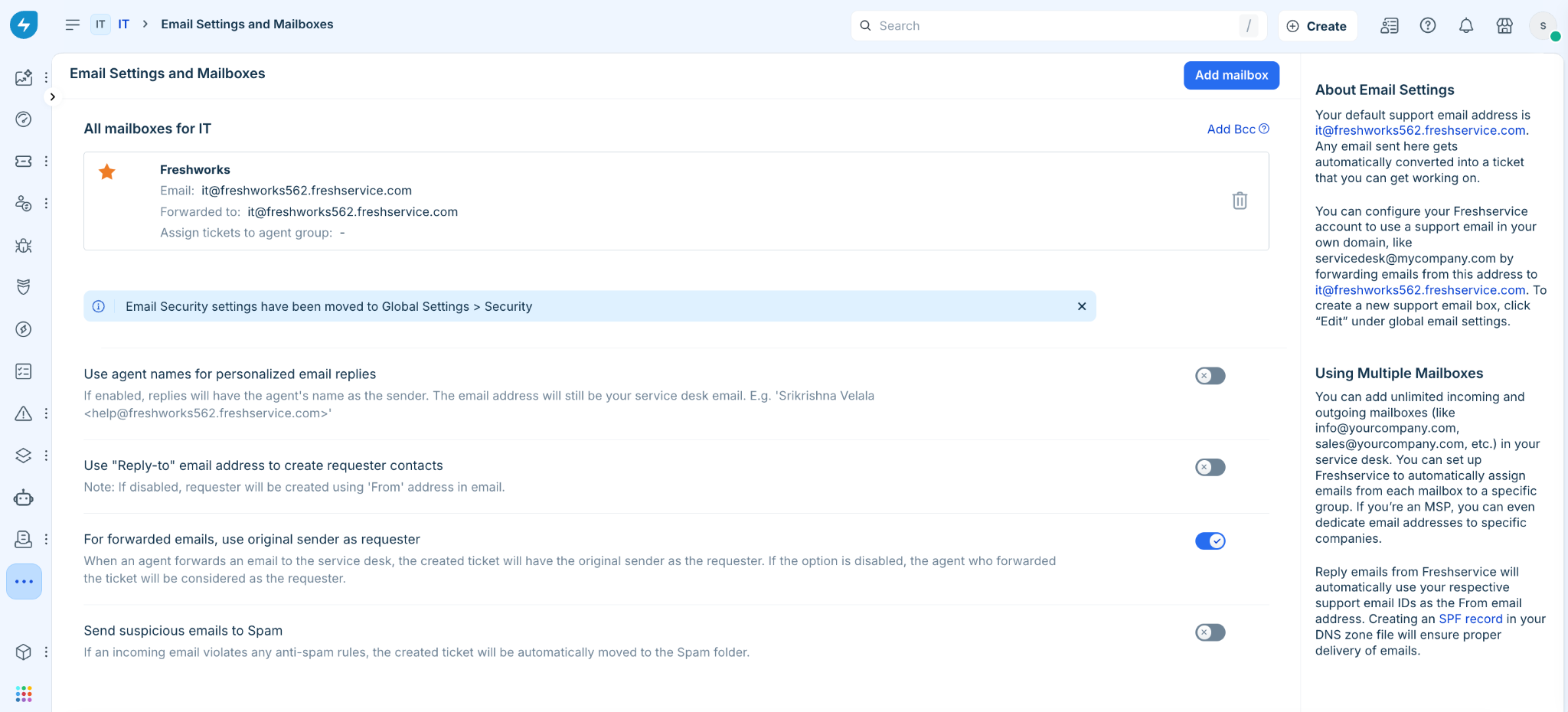
Freshservice will not convert an email into a ticket if its 'From' and 'To' addresses are identical. Likewise, ticket creation is prevented when the 'Reply-to' address matches the 'To' address.
To verify whether a ticket has been categorized as spam, go to Tickets > List, click the three dots icon in the upper-left corner, and choose Spam to see if it appears in that view.
Frequently asked questions (FAQs)
This FAQ section addresses common issues and configurations related to email-to-ticket conversion, threading logic, domain settings, and reply processing in Freshservice.
Email threading and merging
1. Why are incoming emails appended to existing tickets instead of creating new ones?
Freshservice uses backend email threading logic to determine whether an incoming email should create a new ticket or append to an existing one. An incoming email is appended as a note or reply to an existing ticket when it satisfies specific criteria:
Identification criteria: The email subject contains a valid ticket ID format (such as [#INC-12345]), or the email header contains matching Message-ID or References headers linked to a prior email.
Sender validation: The sender's email address matches an existing requester, assigned agent, CC'd recipient, or forwarded contact on the ticket.
Note: If incoming emails are incorrectly appending to existing tickets, ask your administrator to review your Advanced Email Settings (for example, configuring ticket ID prefixes or subject line rules).
2. Why are replies to mass emails or automated requests (such as Adobe Sign) merging into a single ticket?
Automated services and mass email blasts often issue messages that share an identical backend Message-ID. When recipients reply, their email clients include In-Reply-To or References headers referencing that shared ID. Because Freshservice relies on these headers to group messages, it treats incoming replies from completely different recipients as part of the same thread and appends them to a single ticket.
If replies are creating duplicate tickets instead of appending, add the secondary senders or distribution lists to the ticket's CC list. Freshservice will then recognize them as authorized senders and thread their replies to the existing ticket.
If automated tools (like Adobe Sign) are incorrectly merging replies, configure the external service to issue individual emails rather than multi-recipient BCC blasts. Alternatively, set up mail server rules (in Microsoft 365 or Google Workspace) to strip In-Reply-To and References headers from incoming system emails before they hit Freshservice.
3. Why do email replies fail to thread into existing Freshservice tickets?
Freshservice threads replies using subject line ticket IDs (such as [#INC-12345]) and backend email headers (In-Reply-To and References). Threading failures are rarely caused by the operating system or email client itself, but rather by header alteration or sender mismatches.
To resolve email threading issues:
Keep ticket IDs intact: Ensure users do not remove or alter the ticket tag (example, [#INC-12345]) in the subject line when replying.
Check email gateways and add-ins: Inspect mail server flow rules, secure email gateways, and local Outlook add-ins to ensure they are not stripping In-Reply-To or References headers from outbound mail.
Verify sender addresses: Ensure the email address sending the reply is listed on the ticket as the Requester, an Agent, or a CC'd recipient.
Use standard HTML: Ensure Outlook is configured to send outgoing messages as HTML (and never Rich Text/RTF) to prevent message encapsulation issues.
Missing replies and user recognition
4. Why are customer replies not appearing in existing Freshservice tickets?
If a customer reply is present in your mail server inbox (Exchange/Gmail) but missing from the target Freshservice ticket, check the following common causes:
Unregistered email aliases: If a contact replies from a secondary alias or proxy domain not saved on their requester profile, Freshservice creates a new ticket under that alias instead of appending the reply to the existing ticket.
Emails filtered to spam: Messages sent by deactivated/deleted requester profiles or flagged by system spam filters are automatically routed to the Spam folder (Tickets > Spam view).
Missing identifiers (subject tags and headers): If outbound email notifications lack the ticket ID tag ([#{{ticket.id}}]) in the subject line and the sender's mail gateway strips In-Reply-To headers, Freshservice cannot link the reply and will generate a new ticket.
System integration and ticket creation
5. What should I do if emailing the support mailbox fails to create a ticket?
For end-users:
Submit via the web portal: Log into your organization's service portal at https://[your-domain.freshservice.com/support/tickets] to create your request.
Attach email samples: If possible, save the undelivered email as a .eml or .msg file and attach it to your portal request so that the headers can be reviewed.
For administrators:
Verify mail forwarding / IMAP: Ensure your custom support inbox (for example, helpdesk@company.com) is actively forwarding to your default Freshservice address, or re-authorize your OAuth/IMAP connection if using custom mailbox fetching.
Check for email loop prevention: Confirm the sender address is not identical to the target support mailbox address, as Freshservice drops matching From/To emails to prevent loops.
Inspect the spam view: Go to Tickets > Spam view in Freshservice to check if the incoming email was flagged by domain restriction rules, automation triggers, or a deactivated requester account.