
 Community
 Video Library
 Agent Training
 Freshservice
 Freshdesk
 Freshchat
 Freshcaller
 Freshsales
 Freshteam
 Freshworks Neo
 Freshsurvey
 Freshservice for MSP
 Add assets to your Freshservice desk manually. This can be helpful when running a discovery probe is not feasible. It also helps keep track of assets that are outside your network, consumable items, and peripherals. These assets are maintained within the Asset Management module, and it helps maintain properties and relationships similar to assets discovered automatically.
To add an asset or configuration item (CI) to Freshservice manually:
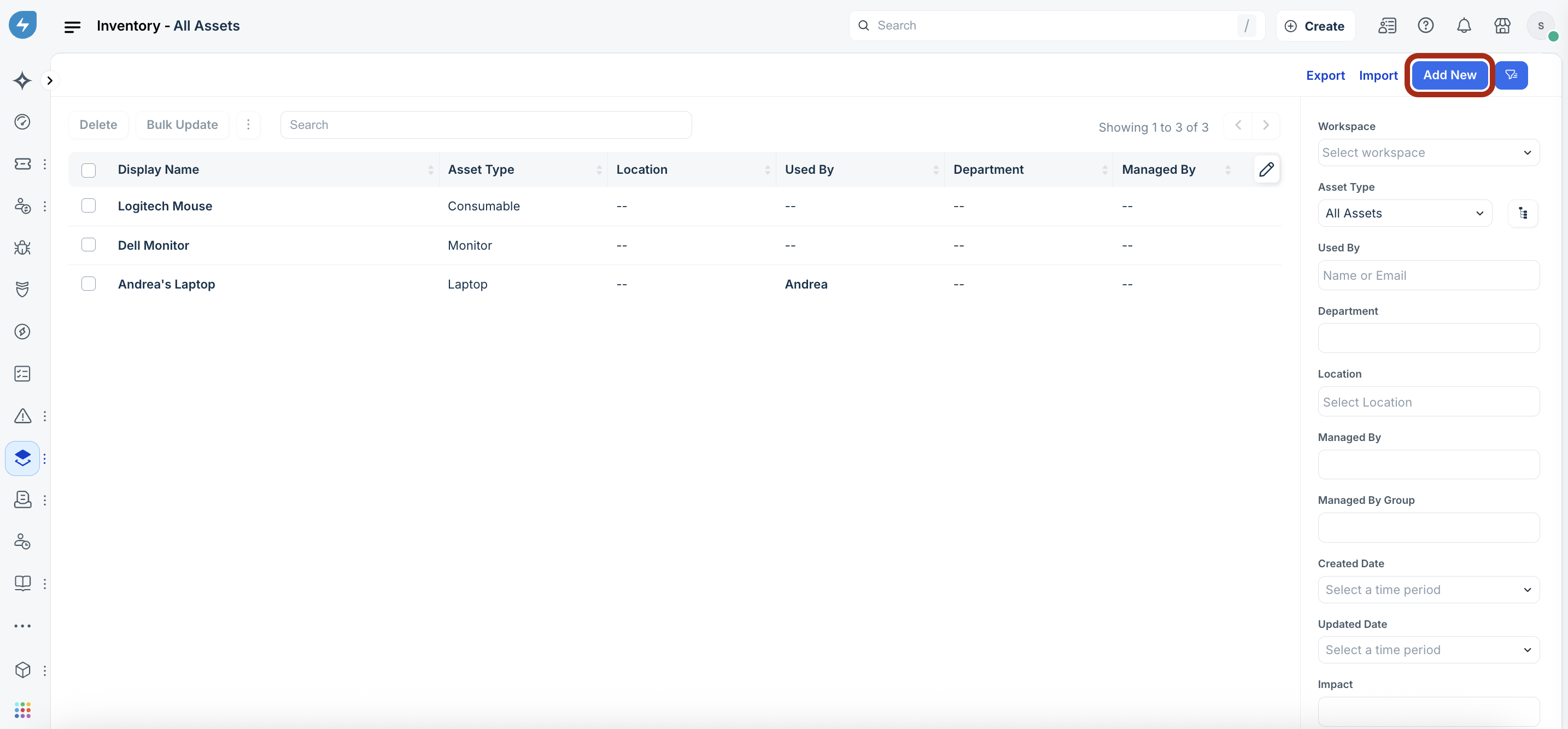
- Go to Assets > Inventory.
- Click Add New.
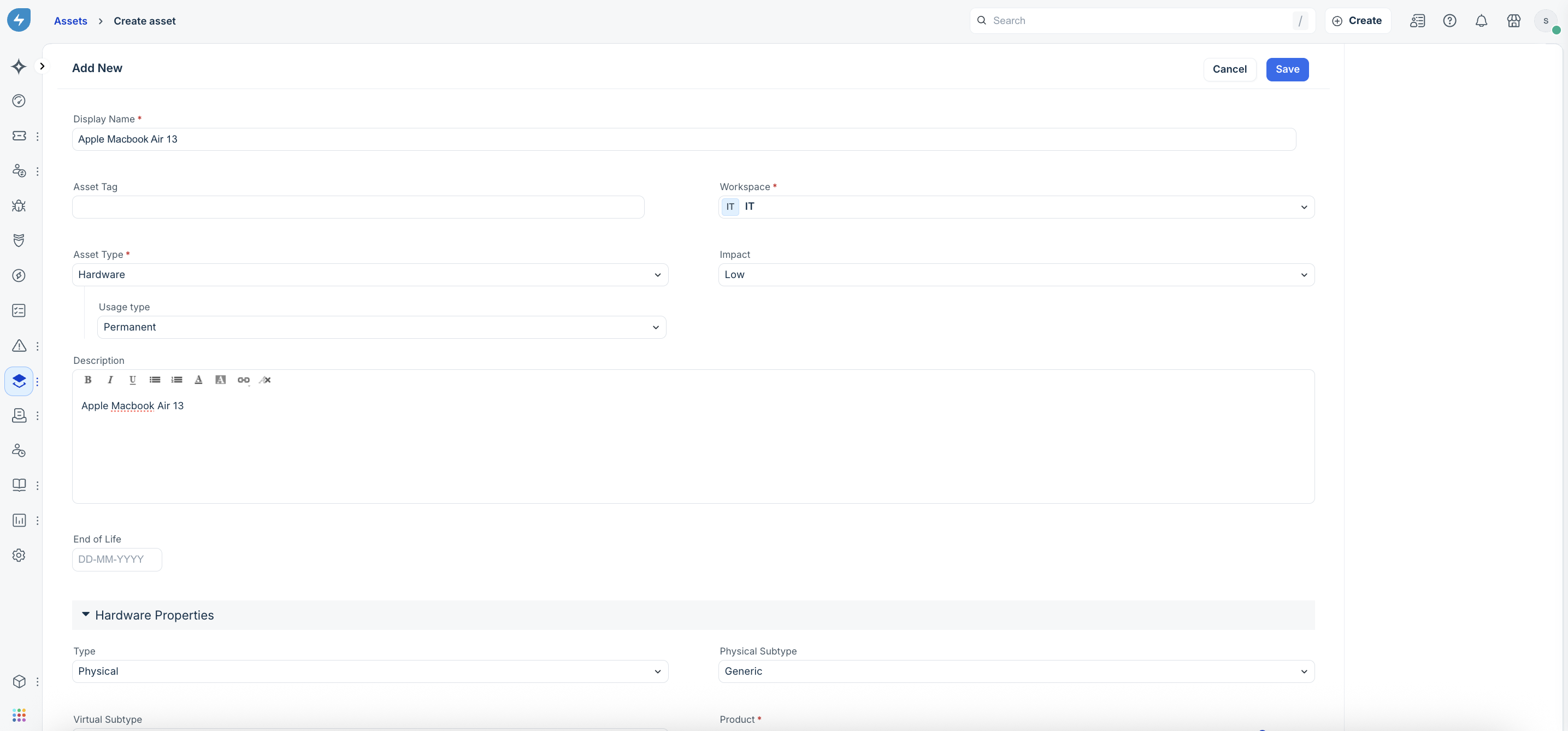
- Enter the display name, asset tag, impact, and description for the CI or asset.
- Select the relevant workspace to add the asset.
- Select the relevant asset type (for example, Hardware), and select the usage type (if applicable).
- Enter relevant details or select relevant options in other sections (such as Hardware Properties, Cost, Assignment).
- Click Save.
Your new asset will be added to the configuration management database (CMDB) / Asset Management module. Now, you can track and manage your CIs/assets.
Determine the cost of the assets
Define the value of the services offered to clients by taking into account all costs. This can be done while creating a new asset within your Inventory. You can capture information related to the Cost of the asset, Salvage value, and Depreciation type.
Assign asset to departments
Assign assets at a Location, Department, Group, or User level while configuring a new asset in the Inventory.
Attach files and asset contract documentation
Add additional information while creating an asset by attaching files and other documentation related to the asset such as invoices, purchase orders, receipts, or proofs of purchase.
Create baselines for assets
Define a new Baseline Asset to compare updated asset records against the baseline records. For example, for a Linux server, you can create a new server asset and name it as the baseline Linux server. This will have the recommended configuration. If any of the discovered Linux servers do not match this record, then it's considered a deviation, thereby highlighting mismatches against the baseline asset.